 Dice Trail
Better decisions, one game at a time.
Dice Trail
Better decisions, one game at a time.
For regular Wingspan base-game players who know the rules. A downloadable 14-page PDF for judging pink powers by your player count and your next best turn.
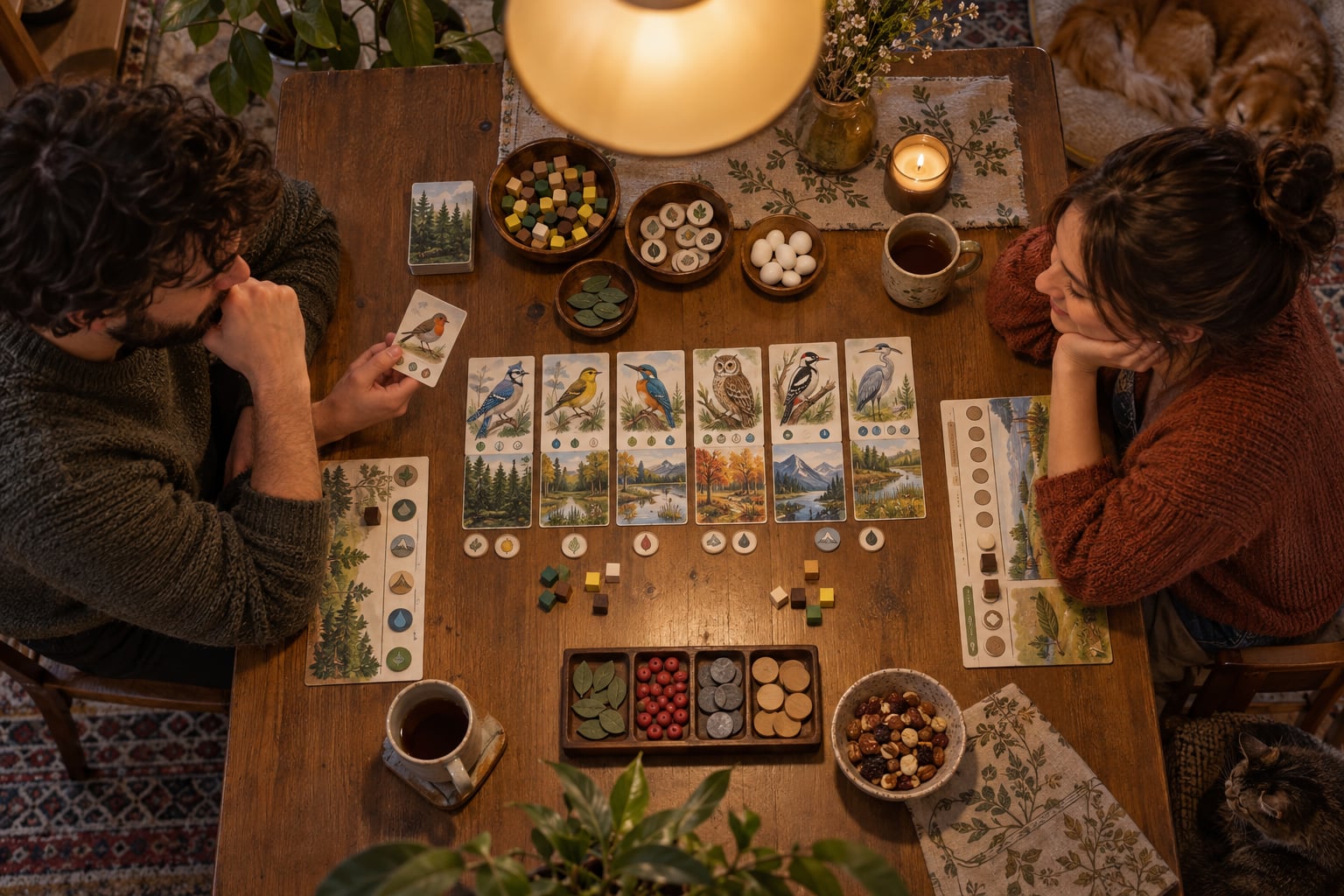
You see an off-turn benefit and count it as a saved action. But your opponents may rarely take the matching action, or the gain may not fit your plan. Meanwhile, playing the bird costs a turn and resources you could have used elsewhere.
Count plausible triggers, read the table, check the timing, then compare the whole play with your best alternative.
Judge plausible activations between your turns instead of relying on the number of opponents.
Use their observed habits and visible goals to reconsider how often the power might trigger.
Check whether enough trigger windows remain to repay the turn and resources spent on the bird.
Weigh the pink-bird play against your best alternative, including points, costs, habitat, and risk.
Return to the guide's decision points when you need to assess a pink power at the table.
The guide has nine sections. The first two preview chapters are shown in full below, so you can judge whether the approach fits your games before buying.
Brown-Headed Cowbird in your hand looks more appealing when three people are about to take turns than when just one is. But its egg-related pink power can pay at most once before your next turn, even if several opponents lay eggs. Three opponents offer three chances to reach that ceiling, not three eggs from the same bird in that interval. At two players, a neighbour who regularly chooses grasslands can be a better prospect than a full table busy gaining food.
Count the intervals in which the bird would be on your board separately from the opponent turns inside each interval. More opponents improve your chance of finding a match; they do not multiply the payout ceiling. A qualifying action is still a possibility, not an appointment. To forecast whether the table will actually supply one, see Rule 2.
| Table size | Opponents before your next turn | Plausible matching actions to look for | Maximum payout from this bird in the interval |
|---|---|---|---|
| 2 players | 1 | That opponent's chosen action | 1 |
| 4 players | 3 | Each opponent's chosen action | 1 |
| 5 players | 4 | Each opponent's chosen action | 1 |
The middle column counts opportunities, not measured probabilities. If all four opponents avoid the qualifying action, the last column is a ceiling you never reach. If the one opponent at two players repeatedly takes it, the smaller table may deliver more dependable eggs across the turns you have left. Neither observation promises an egg next time; opponents have their own plans.
Imagine four players in round 2. One opponent keeps working a grassland row; another has a predator but has not had it succeed. Brown-Headed Cowbird and Turkey Vulture both sit in your hand. The Cowbird asks whether somebody chooses lay eggs and whether you have room on another bird's bowl nest. Turkey Vulture needs an opponent's predator to succeed before you gain from the feeder. That is a narrower chain than simply noticing a predator on a board.
The visible round goal can nudge a player toward eggs, but it cannot make that player take an egg action. Look at their recent choices and the row they have developed, then see whether the goal fits what they are already doing. A single turn is a clue, not a settled habit. This is the missing part of Rule 1's window count: give each possible match a reason grounded in that person's board.
| If you observe | Then infer cautiously | Check next |
|---|---|---|
| Repeated qualifying action | Stronger signal for that action | Will they keep using the same habitat? |
| Relevant egg goal | Possible added reason to lay eggs | Does their board make that goal reachable? |
| Predator on a board | Two hurdles for a success trigger | Does the owner activate it, and does it succeed? |
| No matching action yet | Weak case for this power | What would change their plan? |
A player can pivot to food or cards once a row has done its work. Treat their next choice as fresh information instead of treating your first forecast as a promise. If you are deciding between these two birds, the table of observed actions matters more than the table's head count; at two players, scrutinise the one opponent rather than imagining an average one.
Shown: Rule 1, Count the possible triggers, and Rule 2, Read the actions your opponents prefer. The rest covers the short version, timing, usable gains, comparing turns, common mistakes, a next-game section, and a quick reference.
Judge possible triggers between your turns, with different expectations for two-player and larger games.
Count a gain for what you can use or score, rather than treating every activation as a saved action.
Compare its points, costs, habitat, and risk with what your best alternative turn would gain.
The 14-page PDF covers triggers, opponent habits, timing, usable gains, and the alternative turn. It also includes common mistakes, a next-game section, and a quick reference.
$3.97
Choose your next turn14-page PDF · no subscription · works on any device
If you keep counting every trigger as a saved action, it is easy to overlook the better turn already available to you.